
Youth from Around the World Contribute to a Book on Peace
By David Swanson, World BEYOND War, December 1, 2021
https://worldbeyondwar.org/
Five members of the World BEYOND War Youth Network (WBWYN) from five continents have contributed, together with WBW’s Education Director, to a chapter in a new book (available free in full as PDF) called Problems, Threats and Challenges for Peace and Conflict Resolution, edited by Joanna Marszałek-Kawa Maria Ochwat.
The book provides a highly informative survey of how people in numerous parts of the world view working for peace, primarily meaning the ending of violent conflict within, rather than between, nations.
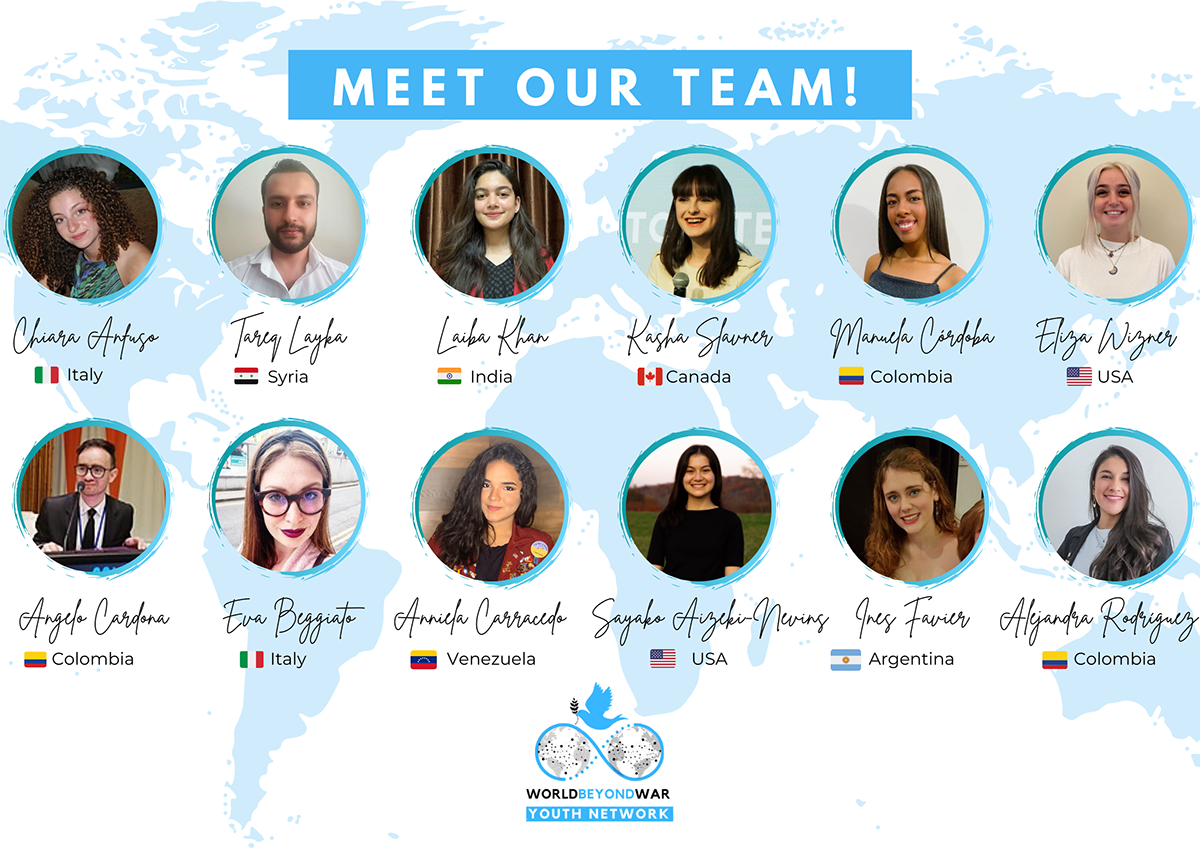
The first chapter was put together by Phill Gittins, World BEYOND War’s Education Director, together with young peace activists Sayako Aizeki-Nevins, Christine Odera, Alejandra Rodriguez, Daria Pakhomova, and Laiba Khan.
Sayako Aizeki-Nevins is a high school student from New York who has found her way from climate and racial-justice activism to activism for peace. “Today,” she writes, “my main interests revolve around the intersections between climate change, militarism, and war. I pursue these interests through my work with the WBWYN.”
Daria Pakhomova is from the Russian Federation and currently studying for a bachelor’s degree in International Relations at Collegium Civitas in Warsaw, Poland.
Aizeki-Nevins and Pakhomova raise similar concerns about the United States and Russia. The former writes that in the United States most young people tell pollsters that they do not plan to join the military, but military advertising and recruiting addresses this vigorously. “[R]ecruiters try to attract students by primarily targeting working-class school districts. They promote the incentives of free college or, for non-citizens, a path to citizenship that can come from military service with honorable discharge. In the past, recruiters have also used video games, such as virtual reality helicopter games, to create a sense of excitement and fun around military activities. These incentives not only cultivate a deceptively innocuous image of the military, but also take advantage of young people – especially undocumented youth, racial minorities, and those from working-class backgrounds. These practices, in addition to the biased curriculum, ensure that many young people are not equipped to participate critically in debates surrounding the U.S. military and war as a practice.”
Pakhomova describes the situation in Russia in somewhat similar terms: “It is noteworthy that a military career is very popular among the young people in Russia. According to one of the major Russian Public Opinion Research Centers, service in the military is one of the most highly regarded professions by Russian youth. Many young males across the country prefer studying at the military academies rather than civilian universities for pragmatic reasons. The tuition fees are mainly covered by the state, cadets are usually accommodated, clothed and fed at governmental expenses, and employment in the military is always guaranteed.”
The poverty draft and the propaganda are problems that the people of the United States and Russia ought to address together.
In the same chapter of this book Christine Odera describes her work for peace in Kenya, where the problems include present, rather than distant, war. Laiba Khan discusses peace work in India. And Alejandra Rodriguez recounts recent activities in war-torn Colombia, writing:
“[I]t can be argued that Colombia’s socioeconomic and cultural dynamics can be defined by the culture of violence that exists in the country. By this I mean a form of violence that goes beyond the physical and governmental, as it is perpetrated by society itself, thus minimizing empathy towards the pain of others and assuming barbarity as a daily occurrence. Still, it is precisely from this point that we as young people must detach ourselves to pursue a different vision of the world and work towards a culture of peace.”
This is a critical point that young people keep telling us. Part of ending war has to be ceasing to indoctrinate young people with acceptance of war. Part of working for peace has to include inspiring young people to do likewise — and being inspired by young people who are doing it.
##
--
David Swanson is an author, activist, journalist, and radio host. He is executive director of WorldBeyondWar.org and campaign coordinator for RootsAction.org. Swanson's books include War Is A Lie.
Copyright mediaforfreedom.com